Erfurt through the centuries 1989–present
Modern Erfurt
Modern Erfurt begins with a struggle for freedom whose consequences were deeply personal. At Andreasstraße, the history of imprisonment meets the history of peaceful civic action—and the continuing work of remembering dictatorship in a democratic city.
1989: a personal history at the turning point
For the creator, Mario V.W.B.R. Obst, the transition from dictatorship to the Peaceful Revolution is inseparable from his own experience. According to the personal chronology he has provided for this archive, he was imprisoned at Andreasstraße on 14 February 1989 and released to the Federal Republic of Germany on 20 October 1989. His account is documented on stasihaft.de. 1
His release came only weeks before the fall of the Berlin Wall on 9 November 1989 and the occupation of Erfurt’s Stasi headquarters on 4 December 1989. These dates place an individual experience of imprisonment and release alongside the public events that transformed the country. They also show why 1989 cannot be understood only through its best-known images of celebration. 2 3
For this archive, his testimony gives the transition a personal point of reference. The account remains his own experience, while the wider history of the revolution includes many people with different lives and roles. His voluntary work at the Andreasstraße memorial connects that personal history with the continuing task of communicating what dictatorship meant. 1
4 December: citizens enter the Stasi headquarters
The opening of the Berlin Wall did not immediately end the work of the state security apparatus. By December, the destruction of Stasi records had become an urgent concern for citizens seeking to preserve evidence of surveillance and repression. In Erfurt, women from the civic initiative Frauen für Veränderung—Women for Change—initiated the occupation of the district headquarters on 4 December. Other activists joined them. 3
With military prosecutors, citizens secured and sealed archival holdings. Their intervention helped prevent records from being destroyed. Occupations followed in other cities, making Erfurt an important starting point in the public dismantling of the Stasi’s power. 3
The significance was practical as well as symbolic. Preserving documents made later investigation possible. A place associated with secret decisions and imprisonment became a place where citizens demanded accountability. That change connects the history of the GDR and Stasi with the responsibilities of a democratic society.
1990: rebuilding state institutions
Thuringia was re-established on 3 October 1990, the day of German reunification. The choice of its capital was debated, and parliament selected Erfurt. The city’s new role belonged to the construction of a federal democratic order, distinct from its earlier position within the GDR’s district administration. 4
The state parliament adopted a constitution at the Wartburg in 1993; voters approved it in a referendum in 1994. The sequence matters: the upheaval of 1989 opened possibilities, while the years that followed involved the work of establishing institutions and rules. 4
The Thuringia chapter follows this regional history in greater detail. In Erfurt, it forms part of the context for understanding a city whose public role changed alongside the political system.
A university renewed
The University of Erfurt was re-established in 1994. Its own history connects the new institution with civic efforts to revive the university and with the transformation made possible by 1989–1990. The modern university drew on an older tradition while taking shape in a different political and educational setting. 5
This provides another way to understand renewal. It could involve recovering an institutional name and historical connection, while also creating something new. The medieval university and its modern successor belong to related histories, separated by a long interruption rather than an unbroken institutional life. 5
Andreasstraße as a place of public memory
The Andreasstraße Memorial and Education Centre brings together the history of political imprisonment, the Peaceful Revolution and the testimony of those who experienced them. Its account of the site places the prison and the former district Stasi administration within the same local history, while explaining their different functions. 6
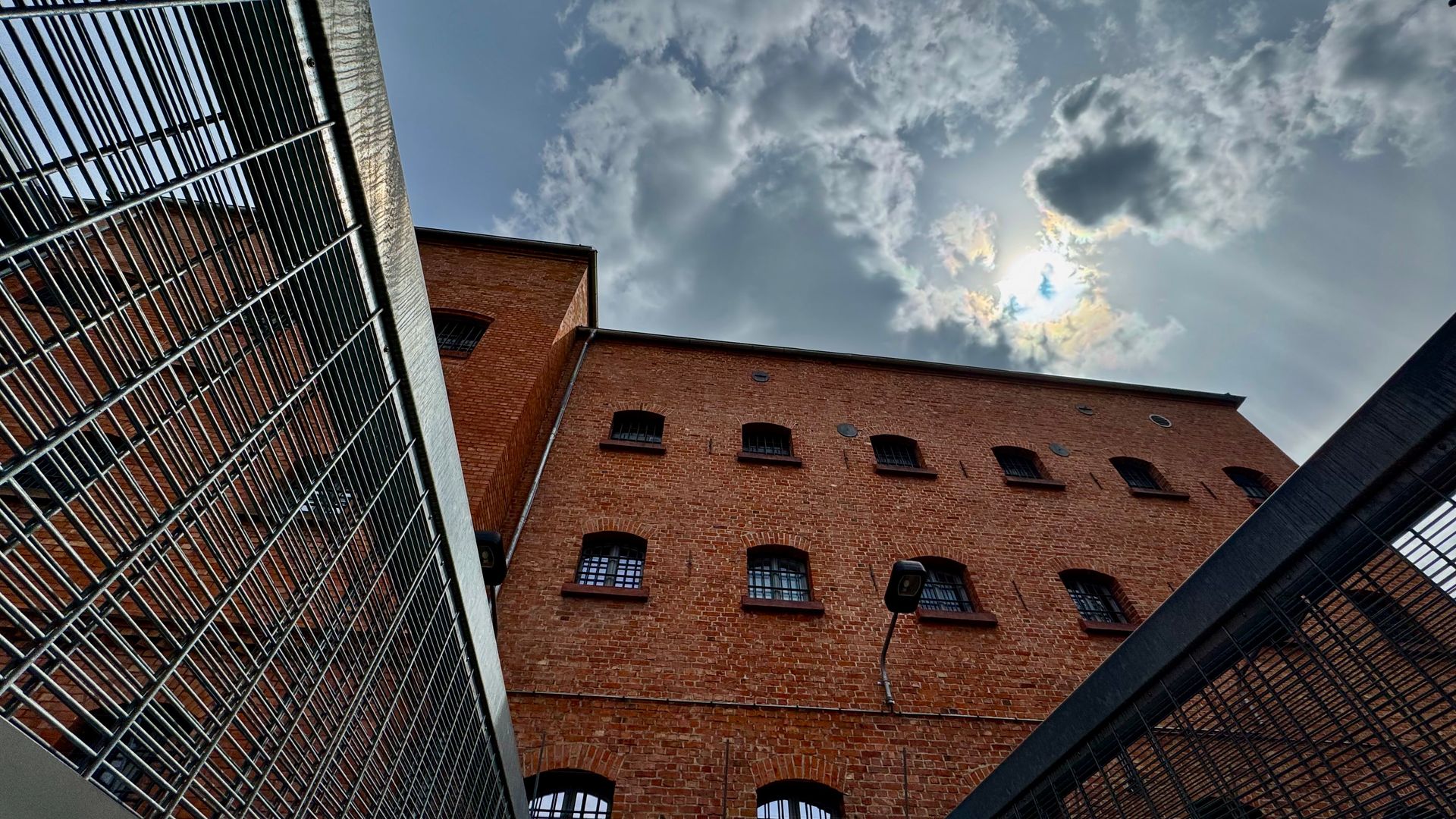
The photograph above, supplied by the creator, keeps the architecture in view: barred windows, brick walls and metal grilles. It accompanies the account as a photograph of the place, not as an image of the events of 1989.
Listening to former prisoners and participants in the revolution is part of the memorial’s educational work. Personal testimony and historical documents offer different forms of evidence; together they help make the consequences of state power understandable beyond a list of institutional dates. 6
Heritage and the city of the present
In 2023, Erfurt’s Jewish-Medieval Heritage entered UNESCO’s World Heritage List. The Old Synagogue, Mikveh and Stone House preserve evidence of Jewish religious and domestic life within the medieval city. Their recognition also belongs to modern Erfurt’s history: the work of identifying, studying and caring for inherited places continues in the present. 7
A city can preserve beautiful buildings while asking difficult questions about what happened within and around them. This archive approaches Erfurt through both: its architectural inheritance and the lives affected by political decisions. The creator’s account at stasihaft.de remains a personal contribution to that work of remembrance.
Return to the complete timeline to follow the earlier chapters, or explore Steigerwald for the city’s relationship with its woodland landscape.
Follow the evidence
Sources & further reading
The numbered references connect the text to its sources. Source titles below are given in English; the linked pages retain their original language.
- 1. Imprisonment in 1989 — the creator’s personal testimony
Mario V.W.B.R. Obst · stasihaft.de (dates also supplied directly by the creator) · German
- 2. 1989 — the year that changed Germany and Europe
German Federal Government · German
- 3. 4 December 1989 — the first occupation of a Stasi office
German Federal Government · German
- 4. The founding of the Free State of Thuringia on 3 October 1990 (PDF)
Thuringian State Archives · German
- 5. History of the University of Erfurt
University of Erfurt · English
- 6. History of the Andreasstraße site
Stiftung Ettersberg · Andreasstraße Memorial and Education Centre · German
- 7. Jewish-Medieval Heritage of Erfurt
UNESCO World Heritage Centre · English
Source check: . This chapter was prepared with AI assistance. Historical interpretation remains open to correction; please send documented corrections to message@erfurt.life.